
Benign Prostatic Hyperplasia
Enlarged prostate, or BPH, a full name is Benign Prostatic Hyperplasia, is a symptom of having an enlarged prostate gland. Which most foreigners would say the size of the prostate is compare to like the fruit of a chestnut but the location of the prostate gland is located under the bladder.
The prostate is responsible for producing the liquefied substance and pour out of approximately 30% of the semen, since the prostate gland covers the first urethra. When the prostate enlarges, it pressurizes as a result, the urethra is compressed, making the urethra smaller causing some patients to have difficulty while urinating.
However, in addition to the enlarged prostate, it will thicken the bladder muscles. This is caused by bladder compression, which forces the urine to flow through a narrow tube. But if the bladder is thicker, there will be less urinary holding. Therefore, as a result, patients with prostatic hyperplasia are encouraged to urinate more often as there may be a sudden urge to urinate frequently and quickly.
An enlarged prostate is found and can be seen generally because it relates to the individual’s age. It has been shown that 50% of people with benign prostatic hyperplasia are around 60 years old. Before that, there was no clear evidence that benign prostatic hyperplasia can cause prostate cancer.
However, everyone must monitor abnormal symptoms in prostatic hyperplasia and prostate cancer because they have similar symptoms. And it is possible that enlarged prostate disease can occur at the same stage. An enlarged prostate can be treated.
What is the prostate gland/what is its function?
The prostate gland is an organ in the male reproductive system. The prostate is about the size of a chestnut. It lies beneath the bladder and is surrounded by the first portion of the urethra. The function of the prostate gland can produce semen, also deliver semen, and produce lubricant from the genitals. In general, the prostate stops growing after about 20 years of age until about 45 years of age and may increase in size again. It is the beginning of prostate disease.
Cause of prostate disease
It is hypothesized that the deterioration of the body causes prostate disease as men’s age decreases and is also caused by hormonal changes and may be caused by genetics as well.
But patients with relatively severe symptoms among the younger age group of 60 years old should be treated by surgery and in a group at risk of about 50 years old and over. However, if the family history encountered a prostate disease before, there may be more chances that it could be repeated.
What are the symptoms of BPH?
1. We will feel the need to urinate more often.
2. The urine may contain blood.
3. It causes the feeling that urination is very annoying each day.
4. There is a feeling that you can’t urinate completely, making you want to urinate more often.
5. Consecutive urination within 2 hours.
6. Urinary Incontinence: I had to rush to the bathroom immediately.
7. Having to strain for longer than normal to excrete the urine
8. Sometimes, you may not be able to urinate at all.
The symptoms generally include not urinating, urinary incontinence, bleeding while urinating, and inability to pass complete urination or straining to urinate for a long time.
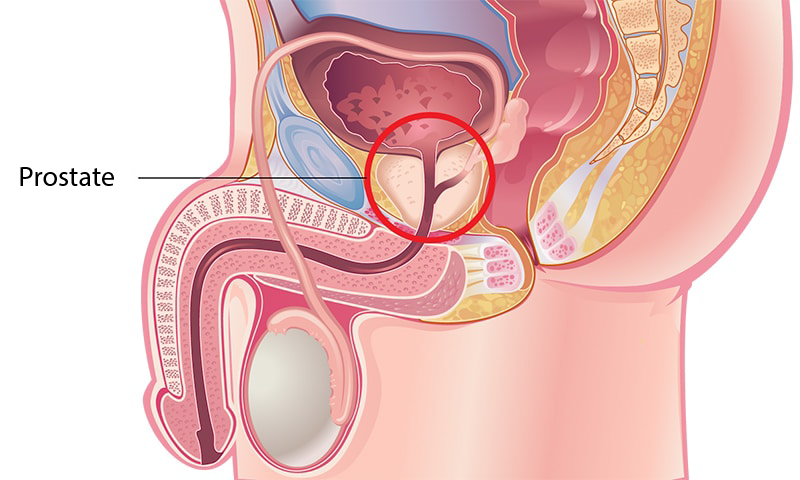
Figure : Showing the position of the prostate gland

Figure : Comparison of normal prostate and Benign Prostatic Hyperplasia

Figure : Prostate examination
Diagnosis of prostatic hyperplasia
Make a preliminary diagnosis yourself by monitoring for symptoms and abnormalities in the body’s ability to urinate. If you urinate more often and while urinating, you feel pain or must push for longer to complete your urination. It is advised that you should see a doctor immediately.
Diagnosed by a doctor before you go to the doctor, it is necessary to perform a physical examination to determine if there is an abnormality in urination caused by prostatic hyperplasia. After going through the preliminary history of the treatment, the doctor will focus on the matter of the urinary tract. To tests for the prostatic hyperplasia, the doctor may diagnose the following symptoms:
Rectal examination (DRE Style) is a rectal examination in which a finger is inserted to check for prostate gland abnormalities. In addition, a rectal examination may be able to make only an initial diagnosis and cannot determine the severity of the disease.
Urinalysis a urinalysis can help determine the nature of your urinary tract infection. Testing for substances indicating prostate cancer, Prostate-Specific Antigen (PSA). This test can help doctors determine whether the above symptoms are prostate enlargement or prostate cancer since the two diseases are similar.
The blood creatinine test (Blood Creatinine Test) is a test to check the condition of the kidney functions. The doctor may have to check or observe additional symptoms to tell the exact cause of your symptoms, whether it is a symptom of prostate disease.
After urination a post-voided residual test measures the amount of urine remaining in the bladder. May use an ultrasound (Ultrasound) or use a urinary catheter inserted through the urethra.
Urinary Flow Test measures the strength of the flow of urine. The results can help determine whether the flow of urine is normal. Also, during treatment, this test can help show if the treatment is improving or worsening your symptoms.
Complications of prostate disease
1. Inflammation of the bladder and infection
2. While urinating, there may be blood because the prostate gland may be swollen.
3. Kidney function has deteriorated and may cause kidney failure.
4. Bladder stones
5. Urine may flow back and damage the kidneys.
Enlarged prostate treatment
1. Refrain from drinking large amounts of liquids or alcohol, especially at night.
2. The doctor prescribes medication to the patient, such as muscle relaxants that can help make the prostate gland smaller.
3. Hot temperature treatment can help relieve symptoms of enlarged prostate.
4. Laparoscopic surgery method is a biopsy in the excess. This method is considered a very popular surgical method. Your surgeon will insert a tube with a small camera into your urethra.
Get an initial consultation with Dr.Beer FREE!!!
Ask for information about treatment and additional services make an appointment at
LINE:@ETERNITYCLINIC1
Facebook:@Eternityclinicthai

M.D. SUEBPONG ANGCHOUN
Urologist & General Surgeon of advance Endo-Uro and Laparoscopic Surgery