
Nephrectomy
Kidney Surgery Also Known as Nephrectomy. It is a common surgery in medical practice, It may be a partial resection of the kidney tissue, called partial nephrectomy or it may be a complete removal of one kidney, called total nephrectomy or the removal of one kidney, including the adrenal glands and all nearby lymph nodes is called radical nephrectomy or removal of both kidneys known as a bilateral nephrectomy.
surgical techniques
The first method called conventional open surgery refers to traditional surgery using the principle of major surgery.
The second method is surgery by using a camera, called laparoscopic surgery. Suitable for unilateral nephrectomy than first-line surgery. The surgeon will make an 8-12 inches long incision in the skin at the side of the body. In order for the operation to cause minimal disturbance to the abdominal organs. Sometimes, the surgical wound may come forward or backward depending on the case.
laparoscopic surgery, the surgeon will make four small incisions in the abdominal to insert surgical instruments equipped with camera and various types of surgical aids. After the nephrectomy is complete, the doctor will consider to making another wide incision to bring the kidney out of the body.

Figure : Conventional Open Surgery
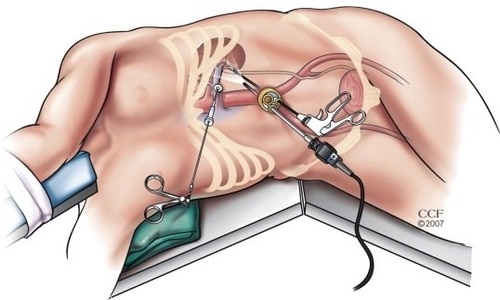
Figure : Laparoscopic Surgery
Both surgeries, conventional open nephrectomy and laparoscopic nephrectomy are performed under general anesthesia. The advantage of endoscopic method is that after surgery, the patient is less painful wound heals faster and less fascia from the surgery. However, the disadvantage is that the surgery takes longer and requires only a skilled surgeon. In the near future, there is a development of a surgery technique called robotic surgery, which is becoming more and more widely used in many countries now.
Nephrectomy in various cases
• In case of cancer Most of them had to have surgery on one kidney including the adrenal glands and nearby lymph nodes
• In case of kidney damage due to infection, kidney stones, kidney cysts or urinary tract obstruction
• In case the patient has severe hypertension due to arteriosclerosis, which causes the destruction of the kidneys, after kidney surgery It will be easier to control blood pressure.
• In case the patient has an accident such as a car accident
• Kidney transplantation
preparation for surgery
• Refrain from taking aspirin and all types of drugs that affect coagulation for at least one week before surgery
• Abstain from food and water after midnight before the surgery day to prevent vomiting during surgery
• Review history of drug allergies, History of past illnesses and surgeries
• In case of suspected pregnancy Immediately tell your doctor
Patient follow-up
After the doctor allow to go home, the doctor will make an appointment for a check-up after a week to check the neatness of the surgical wound and to evaluate the results of the surgery in the initial stage. For conventional open surgery the doctor will recuperate for about 6 weeks and laparoscopic nephrectomy will take about 4 weeks to recover.
Possible Complications
• Harm to nearby organs such as intestines, liver, spleen and pancreas.
• Bleeding in the abdomen or around the surgical wound.
• A leak into the lung cavity during surgery causes the lungs to collapse.
• Decreased lung and respiratory function after surgery.
• Infected surgical wounds
• Kidney function will decrease slightly in the early period after surgery.
• Threats to the nerve near the surgical wound.
• Hernia at the surgical incision
Get an initial consultation with Dr.Beer FREE!!!
Ask for information about treatment and additional services make an appointment at
LINE:@ETERNITYCLINIC1
Facebook:@Eternityclinicthai

M.D. SUEBPONG ANGCHOUN
Urologist & General Surgeon of advance Endo-Uro and Laparoscopic Surgery