
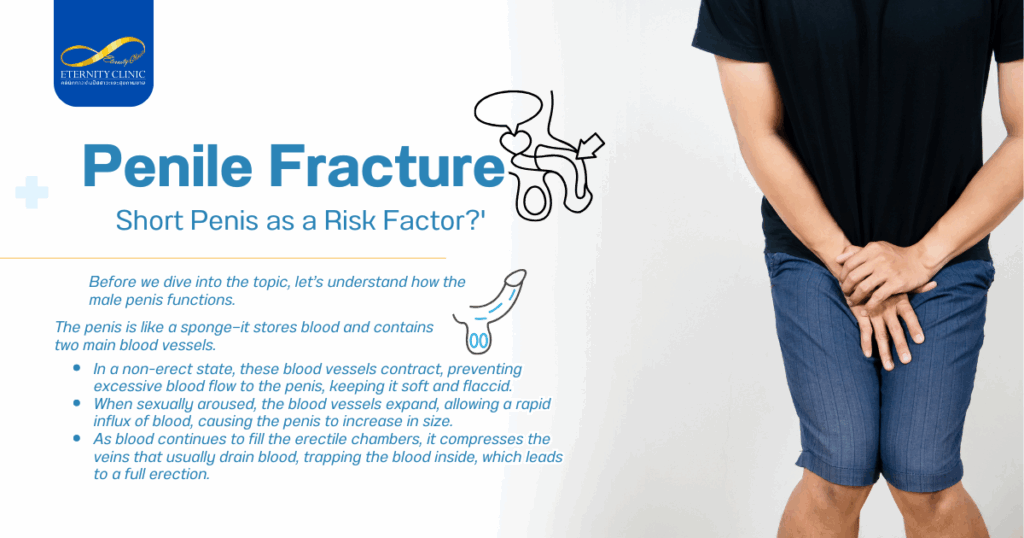
Before we dive into the topic, let’s understand how the male penis functions.
The penis is like a sponge—it stores blood and contains two main blood vessels.
- In a non-erect state, these blood vessels contract, preventing excessive blood flow to the penis, keeping it soft and flaccid.
- When sexually aroused, the blood vessels expand, allowing a rapid influx of blood, causing the penis to increase in size.
- As blood continues to fill the erectile chambers, it compresses the veins that usually drain blood, trapping the blood inside, which leads to a full erection.
If you struggle with:
- Weak or incomplete erections
- Wanting a larger and longer penis
Circumcision may help! Bloodless circumcision is now available—quick, clean, and painless. For expert advice, consult Dr. Beer (Dr. Sueppong Engchuan) or click [services] for more details.
Can the Penis “Break”?
Technically speaking, the penis doesn’t have bones, so it cannot break like a bone. However, what people refer to as “penile fracture” is actually a tear in the tunica albuginea, the fibrous tissue surrounding the erectile chambers.
A penile fracture is a real and serious injury.

Who Is at Risk?
Penile fractures happen more frequently in younger men and are less common in older men due to:
- Less intense erections as men age
- Less aggressive sexual activity
Most penile fractures occur when the penis is fully erect and subjected to sudden bending or impact—often during vigorous sex.
The most dangerous sex positions for penile fractures:
- Woman on Top (50% of cases) – The riskiest position, as the woman controls the movement and may accidentally bend the penis.
- Doggy Style (29%) – Deep penetration and thrusting at the wrong angle can cause injury.
- Missionary (21%) – Although less risky, sudden thrusting mistakes can still lead to injury.
Signs & Symptoms of a Penile Fracture
If a penile fracture occurs, you will likely experience:
- Severe, immediate pain
- A loud “popping” sound (from the tissue tearing)
- Rapid loss of erection
- Swelling and bruising (turning dark purple or greenish)
Treatment for Penile Fracture
Emergency surgery is required.
The torn tissue must be repaired within 72 hours to prevent complications. If surgery is delayed, scar tissue forms, making correction nearly impossible.
If left untreated:
- The penis may become permanently curved or deformed.
- Erectile function may be permanently lost.
If treated promptly:
- Most men can regain full function within 4-6 weeks.
Can Penis Enlargement Reduce the Risk?
- A longer penis may reduce the risk of sudden bending injuries.
- Larger girth can improve structural support.
If you’re interested in enhancing penis size safely, consult Dr. Beer at Eternity Clinic, a specialist in urology and men’s health.
Need expert advice? Book a consultation today!
Q&A About Penile Fracture: Short Penis as a Risk Factor?’
Q1: How does an erection work?
A: Blood flows into the penis, fills the erectile chambers, and the veins get compressed, which traps blood and creates firmness.
Q2: Can the penis actually “break”?
A: There’s no bone, but a penile fracture can happen when the tough tissue (tunica albuginea) tears during sudden bending.
Q3: What are signs of a penile fracture?
A: Sudden severe pain, a “pop” sound, rapid loss of erection, swelling, and bruising.
Q4: What causes penile fracture most often?
A: It usually happens during vigorous sex when an erect penis is bent suddenly—commonly reported in positions like woman-on-top or doggy style.
Q5: Is penile fracture an emergency and how is it treated?
A: Yes. It’s a medical emergency and often needs urgent surgical repair, ideally as soon as possible, to reduce long-term problems.

Get an initial consultation with Dr.Beer FREE!!!
Ask for information about treatment and additional services make an appointment at
LINE:@ETERNITYCLINIC2
M.D. SUEBPONG ANGCHOUN
Urologist & General Surgeon of advance Endo-Uro and Laparoscopic Surgery
Latest Articles
Can You Really Make Your Penis Bigger?
Does Penis Size Matter? The answer varies from person to person. However, many men have
Can You Enlarge Your Penis Naturally Fact or Fiction?
Enlarge penis — Let’s be honest, penis size is one of those topics that men
Risky or Worth It? Popular Penis Enlargement Techniques
In today’s world, where confidence matters more than ever, many men are turning their attention
Want to Go Bigger? Safe and Proven Penis Enlargement Options
In today’s world, self-confidence plays a vital role in how we live and interact. For
Just by Changing a Few Habits Can Improve Penis Length?
Improve Penis Length | When it comes to penis size, many men can’t help but
Breakthrough Techniques! Can You Really Increase Penis Length?
Penis length has long been a hot topic, especially among men who often associate it
How to Increase Penis Length Without Ruining Your Health
Penis length is a topic that many men worry about, often quietly. This leads to
The Hidden Truth: Why Your Penis Isn’t as Big as You Expect
For many men, penis size can be a source of insecurity. Some wonder why their