
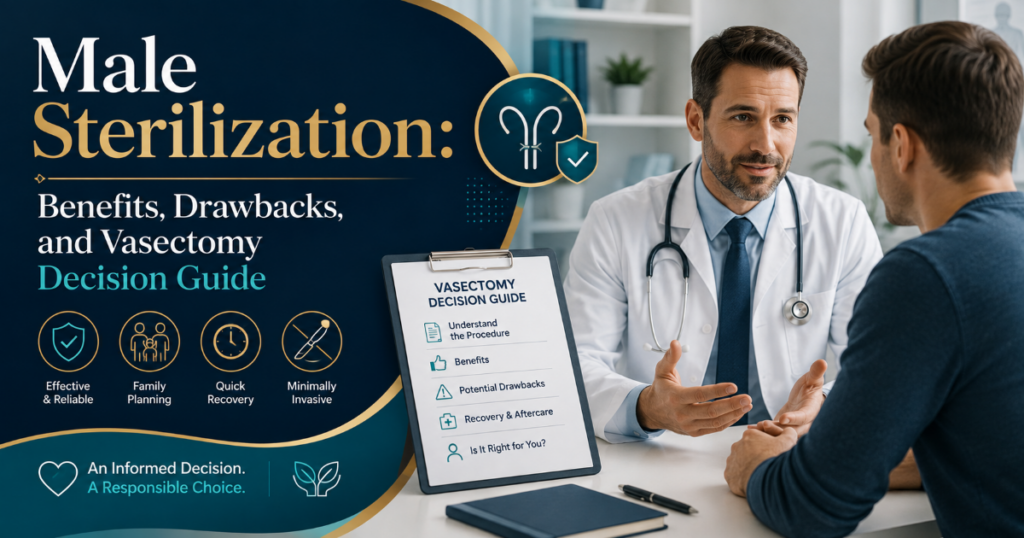
Male sterilization, usually performed as a vasectomy, is a long-term birth control option for men who are confident they do not want future biological children. This guide explains the benefits, drawbacks, recovery expectations, semen analysis, reversibility limits, and common myths about sex life and masculinity.
Male sterilization means vasectomy in most clinical contexts. The doctor blocks or seals the vas deferens so sperm can no longer enter semen. It is highly effective after semen testing confirms clearance, but it is not immediately effective on the day of the procedure and it does not protect against sexually transmitted infections.
What Is Male Sterilization?
Male sterilization is a permanent contraception method for men. The common medical procedure is vasectomy, where the vas deferens on each side is cut, sealed, clipped, cauterized, or otherwise blocked so sperm cannot travel from the testicles into the semen.
The testicles still make sperm after vasectomy. The body reabsorbs sperm naturally. Semen volume usually changes very little because most semen fluid comes from glands other than the testicles. The main intended result is contraception after clearance, not sexual performance enhancement.

Benefits of Male Sterilization
The main benefit is reliable long-term contraception after post-vasectomy semen analysis confirms that the semen is clear of sperm. For couples who are certain their family is complete, male sterilization can reduce dependence on ongoing female hormonal contraception, intrauterine devices, or repeat pregnancy-prevention planning.
Long-term contraception
It is designed as a durable contraception option for men who are certain about future family planning.
Local-anesthesia procedure
Many vasectomies are performed as outpatient procedures under local anesthesia, depending on patient suitability.
No direct hormonal change
Vasectomy does not remove the testicles and should not directly lower testosterone, libido, erections, or orgasm.

| Potential benefit | What it means | What to clarify first |
|---|---|---|
| High effectiveness after clearance | Pregnancy risk becomes very low after semen analysis confirms success. | It is not immediately effective. Continue contraception until cleared. |
| Shared family planning | The male partner can take a direct role in permanent contraception. | Both partners should understand permanence and alternatives. |
| No daily pill or device | No daily contraceptive action is needed after confirmed clearance. | It does not prevent sexually transmitted infections. |
| Short procedure time | Many cases are completed as a minor outpatient procedure. | Technique, anesthesia, and recovery depend on assessment. |
Drawbacks, Limits, and Trade-Offs
The biggest drawback is permanence. Vasectomy is appropriate only when a man is confident he does not want future biological children, or after he has carefully considered sperm banking and other options. It should not be chosen because of short-term pressure, temporary relationship conflict, or incomplete counselling.
Not immediately effective
- Sperm can remain in the semen after the procedure.
- Alternative contraception is required until post-vasectomy semen analysis confirms clearance.
- Follow-up testing is part of the procedure, not an optional extra.
Reversal is not a safety net
- Reversal is more complex than vasectomy.
- Success depends on timing, technique, surgeon expertise, and partner factors.
- Pregnancy after reversal is not guaranteed.
Common Myths About Male Sterilization
Many men hesitate because they worry that vasectomy will make them less masculine, reduce sexual performance, or change ejaculation. Most of these fears confuse sperm transport with hormone production and erectile function.
| Myth | More accurate explanation | When to seek separate care |
|---|---|---|
| Vasectomy lowers testosterone | Vasectomy blocks sperm transport. It does not remove the testicles, where testosterone is produced. | Low libido, fatigue, or suspected low testosterone should be evaluated separately. |
| Vasectomy causes erectile dysfunction | It should not directly impair the erection mechanism. Anxiety, vascular disease, diabetes, and medications are separate ED factors. | Ongoing ED needs a men’s health assessment. |
| Vasectomy is instantly effective | Sperm may remain for weeks or months. Semen analysis is needed before stopping contraception. | Do not stop contraception until the doctor confirms clearance. |
| Vasectomy protects against STIs | It prevents sperm from entering semen; it does not block infections. | Use condoms or STI testing when risk is present. |
| Reversal always works | Reversal is possible in selected cases but is not guaranteed. | Discuss sperm banking before vasectomy if future fertility is uncertain. |
Procedure Overview: Conventional vs. No-Scalpel Vasectomy
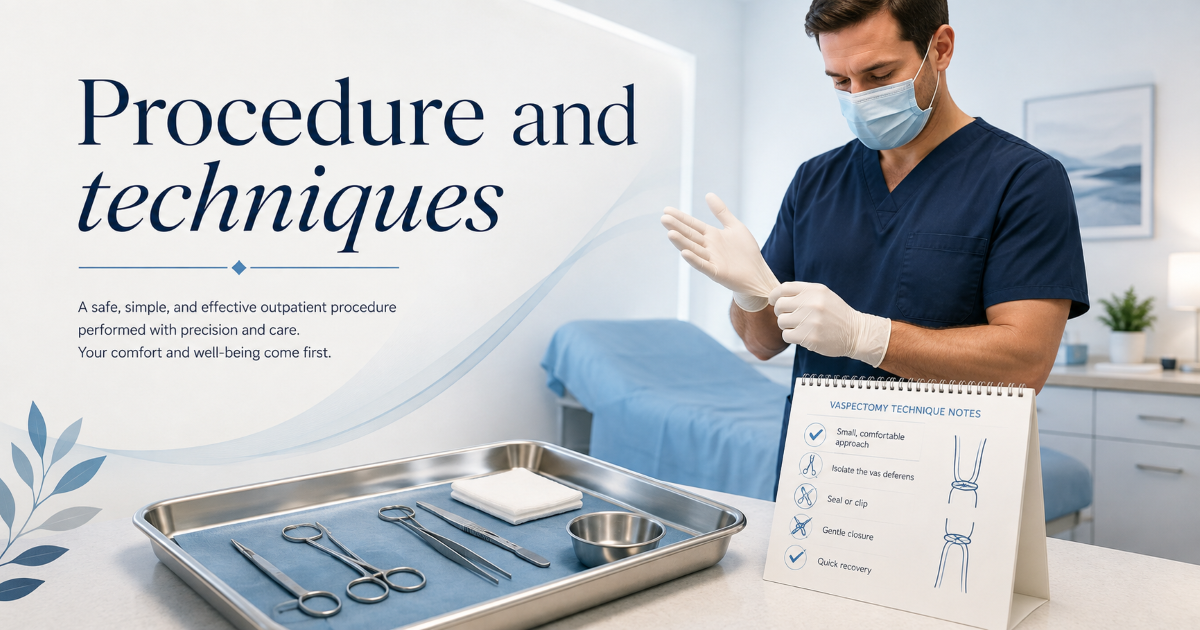
Vasectomy techniques vary by clinic and doctor training. In general, the doctor accesses each vas deferens through a small opening in the scrotal skin, then blocks the tube so sperm cannot pass through. The exact occlusion method may include cutting, cautery, clips, fascial interposition, or a combination.
| Technique | How it is commonly described | Patient discussion point |
|---|---|---|
| Conventional vasectomy | Small incision or incisions are made to access the vas deferens. | Ask about anesthesia, wound closure, recovery, and complication monitoring. |
| No-scalpel vasectomy | A small puncture opening is used to access the vas deferens with specialized instruments. | It may reduce some wound-related issues, but still requires sterile technique and follow-up. |
| Occlusion method | The vas deferens is blocked by the doctor’s chosen technique. | Ask how success is confirmed and when semen analysis is scheduled. |
Recovery, Sex, and Semen Analysis
Recovery instructions vary by doctor, but common goals are to reduce bleeding, swelling, and wound irritation while the scrotal skin heals. Patients are usually advised to rest, use scrotal support, avoid heavy exercise for a short period, and follow the clinic’s wound-care instructions.

First 24 to 48 hours
Rest, limit movement, use support as advised, and monitor swelling, bruising, bleeding, and pain.
Return to activity
Light daily activity may resume according to doctor advice. Heavy lifting, strenuous exercise, and vigorous sex should wait until cleared.
Sex after vasectomy
Sex can resume when discomfort has settled and the doctor says it is appropriate, but contraception must continue until semen testing confirms clearance.
Post-vasectomy semen analysis
This test checks whether sperm remain in the semen. Do not rely on vasectomy for contraception until clearance is confirmed.

Can Male Sterilization Be Reversed?
Vasectomy reversal reconnects the reproductive tract in an attempt to allow sperm to enter semen again. It is a different and more complex procedure than vasectomy. Fertility after reversal can be affected by the time since vasectomy, surgical technique, scarring, sperm quality, female partner age, and other fertility factors.

Possible, not guaranteed
Reversal may be considered in selected cases, but success is variable and pregnancy is not assured.
Cost and complexity
Reversal can be more expensive, technically demanding, and recovery-intensive than the original vasectomy.
Plan before vasectomy
If future fertility is uncertain, discuss sperm banking or delaying vasectomy before making a permanent choice.
Warning Signs After Vasectomy
Some soreness, mild swelling, or bruising can occur after a vasectomy. However, worsening symptoms should not be ignored. Contact the clinic or seek medical care if symptoms suggest infection, bleeding, severe inflammation, or persistent pain.
| Symptom | Why it matters | Suggested action |
|---|---|---|
| Fever, pus, foul odor, spreading redness | Possible infection | Contact a doctor promptly. |
| Heavy bleeding or rapidly increasing swelling | Possible bleeding or hematoma | Seek medical advice quickly. |
| Severe pain not improving | May need reassessment or pain management | Do not wait if pain escalates. |
| Wound opening or discharge | May affect healing and infection risk | Keep the area clean and contact the clinic. |
| Ongoing scrotal pain affecting life or sex | Could represent chronic post-vasectomy pain in a small number of patients | Schedule a urologic review. |
FAQ About Male Sterilization and Vasectomy
Is male sterilization the same as vasectomy?
Yes. Male sterilization usually means vasectomy, a procedure that blocks the vas deferens so sperm no longer mixes with semen. It is intended as permanent contraception for men who are confident they do not want future biological children.
Does vasectomy affect testosterone, erections, or orgasm?
Vasectomy blocks sperm transport. It does not remove the testicles and should not directly lower testosterone, erectile ability, libido, orgasm, or masculine strength. If erectile dysfunction or low desire is present, it should be assessed separately.
Is male sterilization effective immediately?
No. Sperm can remain in the reproductive tract after the procedure. Patients should keep using contraception until post-vasectomy semen analysis confirms clearance according to the clinician’s instructions.
Can male sterilization be reversed?
Reversal may be possible in selected cases, but it is more complex than vasectomy, may be costly, and is not guaranteed to restore fertility. Men who may want children later should discuss alternatives such as sperm banking before vasectomy.
Does vasectomy protect against sexually transmitted infections?
No. Vasectomy only helps prevent pregnancy. Condoms or other STI prevention strategies are still needed when there is STI risk.
When should I contact a doctor after vasectomy?
Contact a doctor if you have worsening pain, fever, spreading redness, pus, heavy bleeding, severe swelling, wound opening, or persistent scrotal pain that affects daily life or sex.
Medical References
This page is written for patient education and medical SEO clarity. It does not replace diagnosis, individualized counselling, or consultation with a qualified doctor.
- NHS: Vasectomy male sterilisation
- Mayo Clinic: Vasectomy overview
- American Urological Association: Vasectomy guideline
- Cleveland Clinic: Vasectomy procedure, recovery, and effectiveness
- CDC: Permanent contraception guidance

Doctor Review and Medical Safety
Male sterilization should be discussed as a permanent contraception decision. A proper consultation should cover motivation, partner communication, alternatives, semen analysis timing, recovery, STI limitations, reversal limitations, and warning signs after the procedure.
Reviewed by: Dr. Beer, Eternity Clinic
Last content update: 28 June 2026

Get an initial consultation with Dr.Beer FREE!!!
Ask for information about treatment and additional services make an appointment at
LINE:@ETERNITYCLINIC2
M.D. SUEBPONG ANGCHOUN
Urologist & General Surgeon of advance Endo-Uro and Laparoscopic Surgery
Latest Articles
How many Methods for Increasing Penis Size? This Article Has the Answers.
How Many Methods for Increasing Penis Size? A Doctor-Reviewed Safety Guide Many men search for
Hormone Therapy Without Surgical Gender Transition
Hormone Therapy Without Surgical Gender Transition Hormone therapy can help some transgender and gender-diverse people
Can You Really Make Your Penis Bigger?
Can You Really Make Your Penis Bigger? A bigger-looking penis is not the same as
What Is PSA? What Does a PSA Test Check, and How Is It Related to the Prostate?
What Is PSA? What Does a PSA Test Check, and How Is It Related to
What Is Emergency Contraception? How to Use It Correctly and What to Know Before Use
What Is Emergency Contraception? How to Use It Correctly and What to Know Before Use
10 Techniques to Enhance Sensation During Sexual Intimacy
10 Techniques to Enhance Sensation During Sexual Intimacy Sensation during intimacy is influenced by arousal,
Best Sexual Wellness Devices for Beginners: A Safety Guide for Adults
Best Sexual Wellness Devices for Beginners: A Safety Guide for Adults If you are considering
(N) Adult Sexual Wellness Devices: A Safety Guide Before Use
Adult Sexual Wellness Devices: A Safety Guide Before Use Adult sexual wellness devices should be