
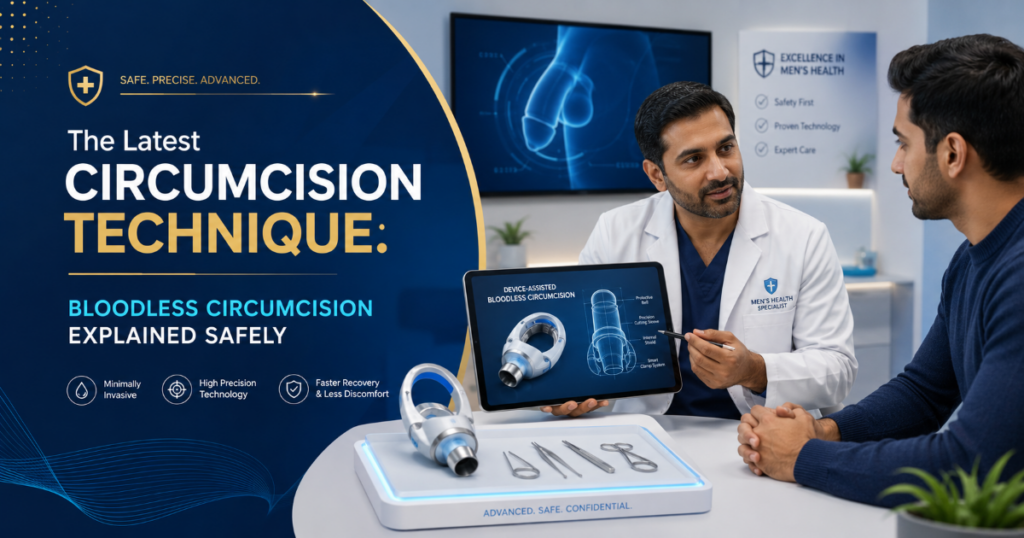
Bloodless circumcision is a common marketing term for device-assisted or staple circumcision techniques designed to reduce bleeding and support consistent wound closure. It does not mean zero bleeding, zero pain, or instant recovery. This guide explains what the technique means, who may be suitable, what to ask before treatment, and how adults should plan recovery safely.
Bloodless circumcision usually refers to a device-assisted circumcision method that cuts the foreskin and closes the wound in a controlled way. It may reduce bleeding in suitable patients, but it is still surgery. Adults should expect swelling, wound care, temporary sensitivity, and several weeks of healing before sexual activity or heavy exercise is resumed. The best method depends on anatomy, foreskin tightness, inflammation, scarring, bleeding risk, and doctor assessment.
Best fit
Adults considering circumcision for long foreskin, tight foreskin, hygiene difficulty, repeated inflammation, or personal preference after medical consultation.
Not a magic term
Bloodless does not mean no bleeding. Minor bleeding, bruising, swelling, discomfort, and wound sensitivity can still occur.
Planning priority
Choose the method based on safety, anatomy, aftercare support, sterile protocol, realistic recovery, and doctor experience.
Table of Contents
1. What is bloodless circumcision?
2. What makes newer device-assisted techniques different?
3. Can you choose how much foreskin is removed?
4. Who may be suitable?
5. What happens during the procedure?
6. Recovery timeline and aftercare
7. Risks, limitations, and warning signs
8. How to choose a circumcision clinic in Bangkok
9. FAQ
What Is Bloodless Circumcision?
Bloodless circumcision is not a formal promise that there will be no blood. In patient-facing language, it usually describes a circumcision technique that uses a device, stapler, clamp, cautery, or other bleeding-control approach to remove the foreskin while helping control bleeding and close the wound.
In adult circumcision, the goal is to remove an appropriate amount of foreskin while protecting the glans, controlling bleeding, and creating a wound edge that can heal safely. The method may be called staple circumcision, device-assisted circumcision, or titanium bloodless circumcision depending on the clinic and device used.

What Makes Newer Device-Assisted Circumcision Techniques Different?
Newer circumcision devices are often designed to make cutting and wound closure more standardized. In suitable patients, this may help with procedure efficiency, wound edge alignment, and bleeding control. However, the device itself does not replace doctor judgment.

| Technique point | What it may help with | What patients should ask |
|---|---|---|
| Device-assisted cutting | May support a more consistent cut line in suitable anatomy. | Is my foreskin anatomy suitable for this device? |
| Staple or closure mechanism | May help approximate wound edges and reduce manual suturing in some cases. | When should staples loosen or be removed if needed? |
| Bleeding-control design | May reduce bleeding compared with less controlled approaches. | What bleeding is still normal and what is not normal? |
| Doctor-led planning | Helps match method, style, and safety to the individual patient. | Why is this method better for my case than another method? |
Can You Choose How Much Foreskin Is Removed?
Some adults ask whether they can choose a minimal, partial, loose, or tight circumcision style. In principle, the amount of foreskin removed can be discussed. In practice, the final plan must be anatomically safe and medically realistic.

Common style goals patients ask about
- Remove only the tight or problematic foreskin
- Keep a looser look when flaccid
- Expose the glans more fully
- Reduce repeated folding, moisture, or irritation
- Create a cleaner, easier-to-maintain appearance
What the doctor must consider
- Foreskin length and thickness
- Frenulum length and tightness
- Scarring from phimosis or inflammation
- Erection skin tension
- Cosmetic expectation and scar placement
For a full style-specific guide, see Circumcision Style: Low, High, Tight, or Loose.
Who May Be Suitable for Bloodless or Device-Assisted Circumcision?
Adults who may benefit from a consultation include men with foreskin-related symptoms or men who prefer circumcision after understanding the risks and permanent nature of the procedure.
| Situation | Why circumcision may be discussed | Important caution |
|---|---|---|
| Tight foreskin or phimosis | Removing the tight foreskin can improve retraction problems and hygiene. | Severity, scarring, infection, and alternatives should be assessed first. |
| Repeated balanitis or irritation | Less trapped moisture may reduce repeated irritation in selected patients. | Diabetes, STI, fungal infection, and skin disease may need separate treatment. |
| Long foreskin with hygiene difficulty | Circumcision can make daily cleaning simpler for some adults. | Hygiene coaching or medical treatment may be enough for some men. |
| Personal or cosmetic preference | Some adults choose circumcision for comfort, appearance, or cultural reasons. | The change is permanent and sensation may feel different after healing. |
| Planning other penile procedures | Some clinics may discuss circumcision before selected filler or aesthetic plans. | This is not necessary for everyone and should be based on medical assessment. |
If tight foreskin is your main concern, read the related guide: Phimosis and Tight Foreskin.
What Happens During the Procedure?
The exact process depends on the clinic protocol and the technique selected. A careful adult circumcision pathway should include assessment, consent, anesthesia planning, sterile preparation, foreskin removal, wound closure, dressing, and aftercare instructions.
Private assessment
The doctor checks foreskin length, phimosis, frenulum, inflammation, scarring, medical history, medication use, allergies, and patient expectations.
Technique and style planning
The doctor explains whether device-assisted circumcision, conventional surgery, or another plan is more suitable. The amount of foreskin removal should be discussed before treatment.
Anesthesia and sterile preparation
Local anesthesia is commonly used for adult circumcision. The area is cleaned and prepared under sterile conditions before the procedure begins.
Foreskin removal and bleeding control
The foreskin is removed using the chosen method. Bleeding is controlled and the wound is closed with staples, sutures, or method-specific closure.
Dressing and aftercare
The clinic applies dressing and gives instructions for cleaning, medication, activity restriction, warning signs, and follow-up.
Recovery Timeline After Bloodless Circumcision
Recovery varies. Patients should not rely on promises such as healed in one week or back to sex immediately. Adult circumcision healing usually requires several weeks, and sexual activity should wait until the wound is medically safe.

| Time period | What may be normal | Aftercare focus |
|---|---|---|
| First 24 to 48 hours | Mild bleeding spots, swelling, soreness, dressing discomfort. | Rest, keep dressing clean, take prescribed medication, avoid alcohol and heavy movement. |
| Days 3 to 7 | Bruising, swelling, sensitivity, tight feeling around the wound. | Clean only as instructed, avoid friction, do not pull staples or wound edges. |
| Weeks 2 to 3 | Swelling gradually improves; staples or wound closure may start loosening depending on method. | Attend follow-up if scheduled. Avoid sex, masturbation, swimming, cycling, and heavy training. |
| Weeks 4 to 6 | Most patients feel more comfortable, but scar firmness and sensitivity may remain. | Ask the doctor before resuming sex or intense exercise. |
| After 6 weeks | Scar maturation continues for months. | Monitor scar comfort, sensitivity, and any late irritation. |
- Keep the wound clean and dry according to clinic instructions.
- Take medication exactly as prescribed.
- Wear supportive underwear to reduce movement and friction.
- Avoid sex and masturbation until the doctor confirms safe healing.
- Avoid swimming, sauna, cycling, and heavy exercise during early recovery.
- Do not remove staples, scabs, or stitches by force.
Risks, Limitations, and Warning Signs
Bloodless circumcision is still circumcision surgery. Any clinic offering adult circumcision should explain possible complications clearly before treatment.
Possible risks
- Bleeding or hematoma
- Infection
- Swelling or bruising
- Delayed healing or wound separation
- Staple irritation or delayed staple release
- Too much or too little skin removed
- Scar sensitivity or tightness
- Change in sensation
- Cosmetic dissatisfaction or revision need
Discuss carefully if you have
- Active penile infection or severe inflammation
- Uncontrolled diabetes
- Bleeding disorder or blood-thinning medication
- Immune suppression
- Previous penile surgery
- Severe scarring or complex phimosis
- Unusual anatomy or urinary symptoms
How to Choose a Circumcision Clinic in Bangkok
International patients should compare clinics by safety and follow-up support, not only by speed, price, or marketing terms. The best clinic for you is the one that can explain candidacy, method choice, recovery, and complication management in a clear, medically responsible way.

| Clinic factor | Why it matters | Question to ask |
|---|---|---|
| Doctor assessment | Confirms whether device-assisted circumcision is appropriate for your anatomy. | Will the doctor examine my foreskin before selecting the method? |
| Method explanation | Patients should understand the difference between conventional surgery, staple circumcision, and bleeding-control techniques. | Why do you recommend this technique for my case? |
| Sterile protocol | Disposable devices and sterile handling reduce cross-contamination risk. | Is the device single-use and how is sterility maintained? |
| Aftercare support | Early advice can help manage bleeding, swelling, dressing issues, or wound concerns. | How do I contact the clinic after treatment if I am worried? |
| Travel planning | Flying, walking, swimming, sex, and exercise need realistic timing after surgery. | How many days should I stay in Bangkok before traveling? |
For the main service page, see Adult Circumcision at Eternity Clinic International.
Book a Private Circumcision Consultation
Send your case for doctor review if you are considering bloodless circumcision, titanium staple circumcision, or adult circumcision in Bangkok. The clinic team can help explain suitability, method options, recovery planning, and next steps.

Doctor Review and Medical Safety
This page is prepared as patient education for adult circumcision, bloodless circumcision, staple circumcision, and phimosis-related planning. Suitability, anesthesia, technique, recovery, and risks must be confirmed during a private doctor consultation.
Reviewed by: Dr. Beer, Eternity Clinic
Last content update: 18 June 2026
Bloodless Circumcision FAQ
Does bloodless circumcision mean no bleeding at all?
No. Bloodless circumcision usually means the technique is designed to reduce or control bleeding. Minor bleeding spots, swelling, bruising, or seepage can still happen because circumcision is surgery.
Is bloodless circumcision painless?
No procedure should be described as guaranteed painless. Local anesthesia is commonly used to reduce pain during the procedure, but soreness, swelling, and sensitivity can occur during recovery.
Is titanium bloodless circumcision suitable for everyone?
Not necessarily. Device-assisted circumcision may be suitable for many adults, but severe phimosis, scarring, infection, thick foreskin, bleeding risk, or unusual anatomy may require a different plan.
How long does recovery take?
Many adults need several weeks for comfortable wound healing. Sexual activity, masturbation, swimming, cycling, and heavy exercise should be avoided until the doctor confirms that healing is safe.
Can I choose minimal, partial, loose, or tight circumcision?
You can discuss your preference with the doctor, but the final plan must be safe for your anatomy, erection skin tension, wound closure, and healing. Not every style is suitable for every patient.
Can circumcision help with phimosis?
Yes. Circumcision is one treatment option for phimosis because it removes the tight foreskin. However, the doctor should assess severity, scarring, infection, and alternatives before choosing treatment.
When should I contact the clinic after circumcision?
Contact the clinic promptly if you have heavy bleeding, fever, pus, worsening redness, severe pain, inability to urinate, blackened skin, rapidly increasing swelling, or significant wound opening.
Medical References
The following references support general medical context for circumcision, risks, recovery, and adult aftercare. They do not replace personalized diagnosis or treatment planning.

Latest Articles
How many Methods for Increasing Penis Size? This Article Has the Answers.
Many men search for ways to increase penis size, but the safest first step is
Hormone Therapy Without Surgical Gender Transition
Hormone therapy can help some transgender and gender-diverse people align physical characteristics with personal goals
What Are the Symptoms of Cystitis? This Article Has the Answers.
Cystitis is inflammation of the bladder. It is often caused by a bacterial bladder infection,
How to Care for Your Manhood to Keep It Strong and Disease-Free
Penis health is not only about sexual performance. It includes daily hygiene, foreskin care, safer
Permanent Solution for Premature Ejaculation with Surgery
Premature ejaculation can be distressing, but it should not be reduced to a single promise
Delayed Ejaculation: Is It Really Good? What to Do If You’re Facing This Issue
Delayed ejaculation may sound positive to some men, but when climax takes much longer than
How to Measure Condom Size Properly: Understanding Sizes 49, 52, 54, and 56
Condom size is not judged by length alone. For most men, the most useful measurement
Penile Enlargement With “Your Own Tissue” or “Your Own Fat”: Why It May Not Be Worth the Pain
Using your own tissue or your own fat can sound more natural than synthetic material,