

Pain during an erection is not something to ignore or self-diagnose. It may come from skin irritation, infection, penile curvature, trauma, prostate or pelvic pain, priapism, medication effects or erectile dysfunction related factors. This guide explains what may be happening, which symptoms are urgent and how a doctor can match treatment to the cause.
What causes pain during an erection?
Painful erections can be caused by infection, inflammation, skin injury, Peyronie’s disease, penile trauma, pelvic floor tension, prostatitis, priapism or other urologic conditions. Erectile dysfunction may coexist, but erection pain is not automatically ED.
The safest next step is to identify the pattern: where the pain is located, how long it lasts, whether the erection goes away normally, whether there are urinary symptoms, discharge, sores, curvature, bruising or testicular pain.
Seek urgent care if you have
- An erection lasting about four hours or longer
- Severe pain after trauma or a popping sensation during sex
- Sudden bruising, swelling or bending after injury
- Fever, discharge, genital sores or severe burning urination
- Severe testicular pain, high-riding testicle or nausea
- Inability to urinate or blood in urine after injury
How a normal erection works
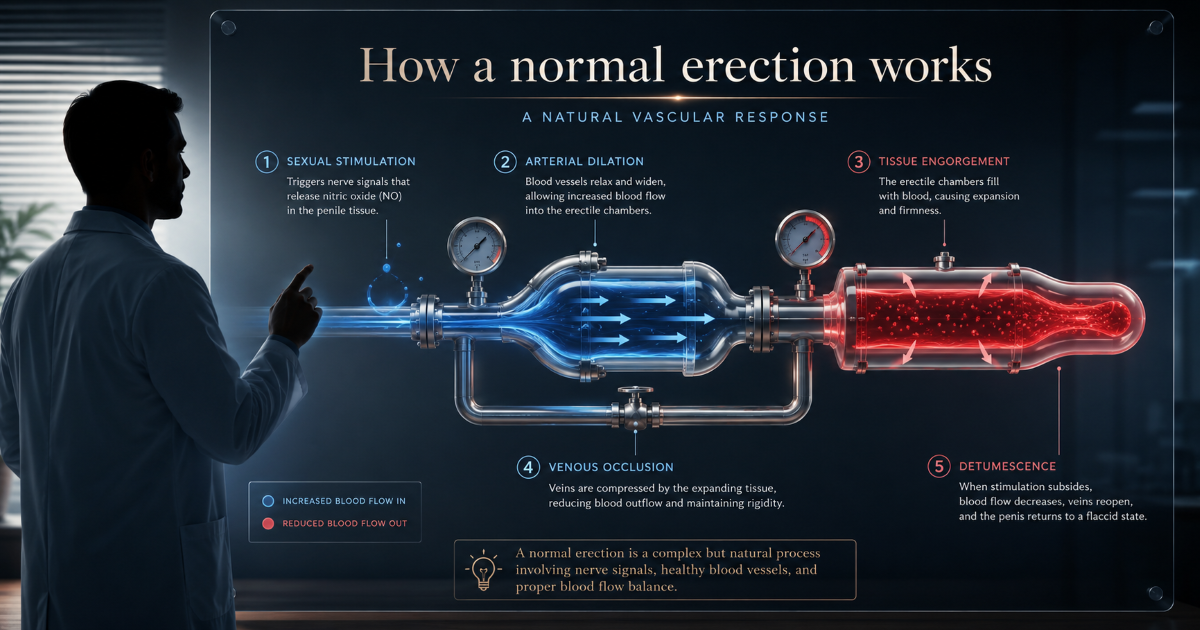
An erection depends on signals from the brain and nerves, relaxation of smooth muscle inside the penis, healthy blood inflow, controlled blood outflow and enough arousal. Pain can appear when any surrounding tissue is inflamed, injured, compressed, scarred or under abnormal pressure.
Vascular problems can affect rigidity and may coexist with ED, but pain usually needs a separate cause-based review.
Nerve irritation or pelvic floor overactivity can create burning, aching or radiating discomfort.
Friction, infection, discharge, sores or inflammation may make erection and sex painful.
Common causes of penile pain during an erection

| Possible cause | What it may feel like | Why assessment matters |
|---|---|---|
| Urethritis or STI-related infection | Burning urination, discharge, urethral pain, genital sores or new pain after unprotected sex. | Testing and targeted medication may be needed. Partners may also need evaluation. |
| Balanitis, skin irritation or friction injury | Redness, soreness, stinging, itching or pain at the glans or foreskin. | May involve hygiene, moisture, allergy, fungal infection, phimosis or skin disease. |
| Peyronie’s disease | Curved erection, painful erection, a hard plaque or indentation during erection. | Early assessment helps determine whether monitoring, medication, traction, injection therapy or surgery is relevant. |
| Penile trauma or fracture | Sudden pain during sex, popping sound, swelling, bruising or rapid loss of erection. | This can be a urologic emergency and should not be treated with home remedies. |
| Priapism | Prolonged painful erection that does not go away normally. | An erection lasting about four hours or longer requires urgent treatment to reduce tissue damage risk. |
| Prostatitis, pelvic floor pain or chronic pelvic pain | Aching at the base of the penis, perineum, pelvis, testicles or after ejaculation. | Treatment may include infection testing, medication, pelvic floor therapy or pain management. |
| ED-related anxiety or vascular ED | Pain may not be the main symptom, but erection difficulty, tension or repeated failed attempts may coexist. | ED workup should include cardiovascular, metabolic, medication and psychological factors. |
Common pain patterns and what they may suggest

May involve irritation, balanitis, herpes, urethritis, dermatitis or friction injury.
May involve STI, urinary infection, urethral inflammation or stone-related irritation.
May suggest Peyronie’s disease, especially if there is a new bend, indentation or palpable plaque.
May involve prostatitis, pelvic floor dysfunction, nerve irritation or chronic pelvic pain syndrome.
May be epididymitis, torsion, hernia, varicocele, referred pain or trauma.
Priapism must be ruled out quickly when an erection does not go away.
Priapism and trauma: when erection pain is urgent
Some painful erection symptoms need same-day or emergency care. Waiting can increase the risk of erectile dysfunction, tissue injury or long-term curvature depending on the diagnosis.
| Symptom | Why it matters | Action |
|---|---|---|
| Prolonged painful erection | May be ischemic priapism, where trapped blood can damage erectile tissue. | Emergency care. |
| Popping sound, bruising or swelling after sex | May be penile fracture or serious tissue injury. | Emergency urology assessment. |
| Severe testicular pain with nausea | May be testicular torsion or severe infection. | Emergency care. |
| Fever, discharge or painful urination | May be infection requiring testing and medication. | Prompt clinic or urgent care assessment. |
How doctors evaluate pain with erection

A proper workup does not only ask whether you can get an erection. It checks the pain pattern, erection quality, urinary symptoms, trauma history, sexual exposure, medications and underlying health conditions.
When did the pain start? Is it every erection, during sex only, after ejaculation or with morning erections?
Glans, shaft, base, urethra, testicle, groin, pelvis, discharge, sores, curvature, bruising or urinary symptoms.
Doctor checks skin, foreskin, glans, shaft plaques, tenderness, curvature signs, scrotum and groin when appropriate.
Urine testing, STI testing, culture or blood tests may be considered when infection, inflammation or systemic disease is suspected.
Penile ultrasound, Doppler study or scrotal ultrasound may be used for selected cases such as trauma, Peyronie’s disease, vascular ED or testicular pain.
If erection strength is also weak, doctors may assess diabetes, blood pressure, cholesterol, smoking, hormones, medication effects and cardiovascular risk.
Treatment options depend on the cause
Treatment should not be chosen only from the word pain. The cause determines whether the plan is simple self-care, medication, infection treatment, pelvic floor treatment, ED treatment or urgent urologic care.
| Diagnosis direction | Possible treatment direction | What to avoid |
|---|---|---|
| Mild friction or irritation | Rest from sex, gentle cleansing, avoid irritants and treat skin cause if present. | Unprescribed steroid or antibiotic creams. |
| STI or urethral infection | Testing, targeted medication and partner management if needed. | Sex before treatment is complete or guessing antibiotics. |
| Peyronie’s disease | Observation, medication, traction, injection therapy or surgery depending on stage, curve and sexual function. | Forceful bending, unproven devices or delaying care when curvature is worsening. |
| Pelvic floor or prostatitis pattern | Medication, pelvic floor therapy, lifestyle triggers review and pain management when appropriate. | Repeated self-treatment without diagnosis. |
| Priapism or trauma | Emergency care, urologic treatment and follow-up. | Waiting for symptoms to disappear when red flags are present. |
| ED with discomfort or anxiety | Cause-based ED workup, lifestyle optimization, PDE5 safety screening, selected ED treatments. | Taking erection medication without checking contraindications. |
How painful erections connect with ED treatment

Some men with erection pain also have weak erections or loss of erection confidence. In that case, the pain must be evaluated first, then the ED pathway can be matched safely. ED treatment is not a substitute for diagnosing pain, infection, trauma or priapism.
May be considered after safety screening, but it is not appropriate for every man and does not treat infection, trauma or priapism.
May be discussed for selected vascular ED cases, not as a general treatment for painful erections.
Usually reserved for severe ED that does not respond to less invasive options. It is not a first-line treatment for pain alone.
Helpful when pain has created avoidance, fear of intercourse or relationship strain.
For broader ED care, see erectile dysfunction treatment. If your doctor suspects vascular ED after pain causes are addressed, shockwave for ED may be reviewed as one possible option for selected patients.
Why international patients should not delay evaluation
Many patients wait because erection pain feels embarrassing. Delay can make some problems more complex, especially when the cause is infection, priapism, penile trauma, progressive curvature or untreated ED risk factors.
- Bring a medication list, including ED medication, antidepressants, supplements and injections.
- Record whether pain occurs during erection, ejaculation, urination or after sex.
- Note curvature changes, palpable lumps, discharge, sores, bruising or urinary symptoms.
- Avoid unverified penile injections, forceful stretching, aggressive massage or self-drainage.
- Seek emergency care first if priapism or traumatic injury is possible.
Medical references
This article was written for patient education and does not replace individual medical diagnosis. Clinical wording was aligned with current patient-facing and guideline sources on priapism, Peyronie’s disease, ED, penile trauma, testicular pain and sexual medicine evaluation.
- Mayo Clinic: Priapism symptoms, causes, diagnosis and treatment – https://www.mayoclinic.org/diseases-conditions/priapism/
- Cleveland Clinic: Priapism and penile fracture patient information – https://my.clevelandclinic.org/health/diseases/10042-priapism
- Mayo Clinic: Peyronie’s disease symptoms and treatment – https://www.mayoclinic.org/diseases-conditions/peyronies-disease/
- NIDDK: Erectile dysfunction symptoms, causes and treatment – https://www.niddk.nih.gov/health-information/urologic-diseases/erectile-dysfunction
- European Association of Urology: Sexual and Reproductive Health Guidelines – https://uroweb.org/guidelines/sexual-and-reproductive-health

Doctor Review and Medical Safety
Painful erections should be assessed by cause, not treated with one-size-fits-all ED medication. At Eternity Clinic International, consultation focuses on symptom pattern, urologic red flags, ED risk screening, medication history and whether urgent referral is needed.
Reviewed by: Dr. Beer, Eternity Clinic
Last content update: 24 June 2026
FAQs about pain during erection
Is pain during an erection always erectile dysfunction?
No. Pain during an erection is not the same as erectile dysfunction. ED means difficulty getting or keeping an erection firm enough for sex. Pain can come from infection, injury, Peyronie’s disease, pelvic floor tension, priapism or other urologic causes. Some men have both pain and ED, so assessment should cover both.
When is a painful erection an emergency?
An erection that lasts about four hours or longer, severe pain after trauma, sudden swelling or bruising, a popping sensation during sex, fever, severe testicular pain or difficulty urinating should be treated as urgent or emergency symptoms.
Can painful erections be caused by Peyronie’s disease?
Yes. Peyronie’s disease involves scar tissue in the penis and may cause curved or painful erections. Not every curve is abnormal, but pain, worsening curvature, erectile difficulty or difficulty with intercourse should be assessed.
Can shockwave treat pain during erection?
Shockwave is not a general treatment for erection pain. It may be discussed only in selected vascular ED cases after assessment. If the main symptom is pain, the cause must be identified first.
Should I avoid sex until the pain is checked?
If pain is severe, new, recurrent or associated with discharge, sores, swelling, urinary symptoms or trauma, avoid sex until you are assessed. Continuing intercourse may worsen irritation or injury depending on the cause.
What tests might be needed?
Depending on symptoms, a doctor may consider physical examination, urine testing, STI testing, blood tests, penile or scrotal ultrasound, erection history review and ED risk screening.
Have pain during erection or weak erections?
Book a confidential men’s health consultation in Bangkok. The goal is to identify the cause first, then match treatment safely instead of guessing from symptoms alone.

Latest Articles
Circumcision at a Clinic vs Hospital: How to Choose the Right Medical Setting
Adult circumcision can be planned in different medical settings. The safest choice depends on your
Adult Circumcision Explained: Benefits, Methods, Recovery, and Safety
Adult circumcision is a procedure to remove the foreskin covering the head of the penis.
Where is the Best Place for Vasectomy (Male Sterilization): Hospital or Clinic?
A vasectomy is a permanent male contraception procedure, but choosing where to have it done
What Sexual Positions Are Best for Men with a Short Penis to Maximize Pleasure in the Bedroom?
A shorter penis or concern about penis size does not automatically mean poor intimacy. Comfort,
How many Methods for Increasing Penis Size? This Article Has the Answers.
Many men search for ways to increase penis size, but the safest first step is
Hormone Therapy Without Surgical Gender Transition
Hormone therapy can help some transgender and gender-diverse people align physical characteristics with personal goals
What Are the Symptoms of Cystitis? This Article Has the Answers.
Cystitis is inflammation of the bladder. It is often caused by a bacterial bladder infection,
How to Care for Your Manhood to Keep It Strong and Disease-Free
Penis health is not only about sexual performance. It includes daily hygiene, foreskin care, safer