
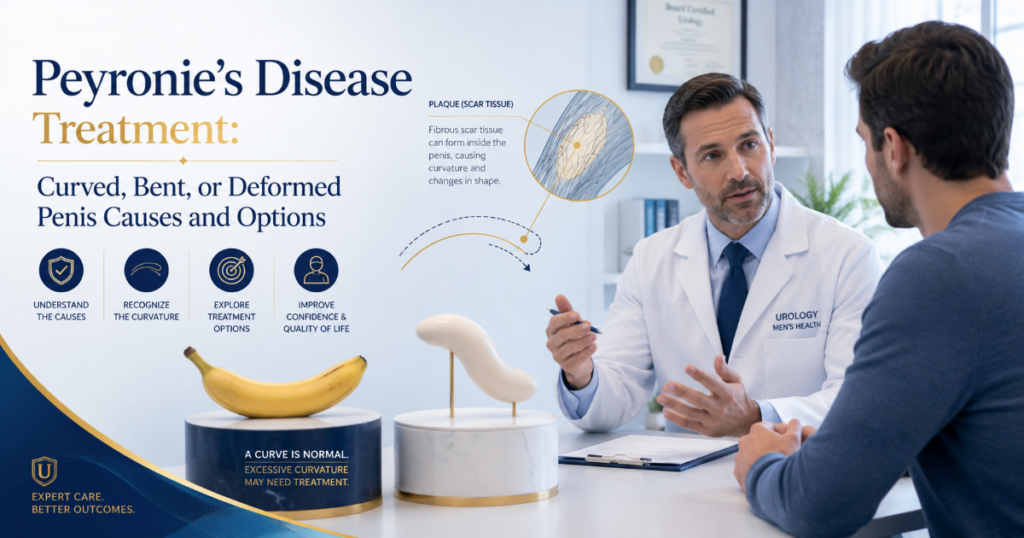
A curved penis can be normal when the bend is mild and sex is comfortable. Peyronie’s disease is different: it is an acquired curvature problem that may involve scar-like plaque, painful erections, shortening, indentation, erectile dysfunction, or difficulty with penetration. This guide explains what to check, when to see a doctor, and which treatment paths may be considered.
Peyronie’s disease is a condition where scar-like plaque develops inside the penis and can pull the erection into a curve, bend, narrowing, hourglass shape, or shortening. It may also cause pain during erection and erectile dysfunction. Treatment is not one-size-fits-all. The right option depends on whether the condition is active or stable, the degree of curvature, pain, plaque features, erectile function, penetration difficulty, and patient expectations.
What Is Peyronie’s Disease?
Peyronie’s disease is an acquired penile curvature condition. It usually develops after puberty and is commonly linked with plaque or scar-like tissue in the tunica albuginea, the firm layer that helps the penis become rigid during an erection. When one area becomes less elastic, the erection may bend toward the affected side.
Symptoms can appear gradually or more suddenly. Some men notice pain first. Others notice a new bend, a hard lump, an indentation, loss of length, reduced girth, or difficulty with sexual intercourse. Peyronie’s disease can also overlap with erectile dysfunction, relationship stress, and anxiety about sexual performance.
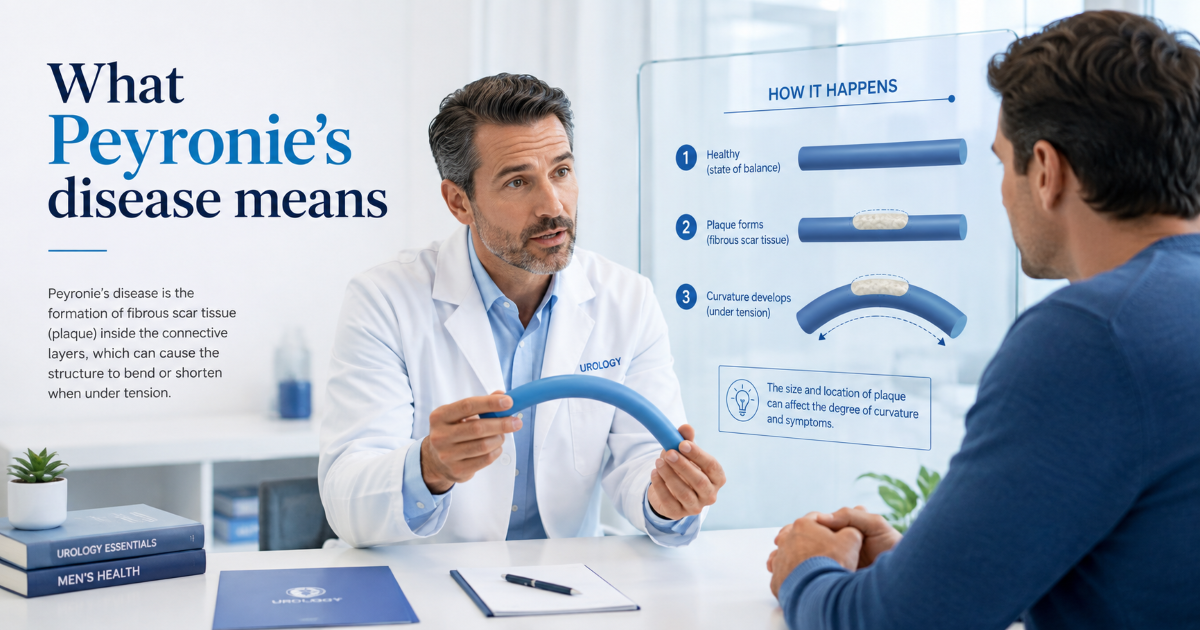
Normal Curvature vs. Peyronie’s Disease
Not every bend is abnormal. Many men have a slight upward, downward, left, or right curve during erection. A mild curve that has always been present and does not cause pain or sexual difficulty may not need medical treatment. A new curve, a curve that is getting worse, pain with erection, a palpable hard area, narrowing, shortening, or difficulty with penetration should be evaluated.
| Feature | Often more consistent with natural curvature | More concerning for Peyronie’s disease |
|---|---|---|
| Timing | Present for many years or since first erections | Develops later or changes over months |
| Pain | No pain during erection or sex | Painful erections, tenderness, or discomfort |
| Shape | Smooth mild bend | New bend, indentation, hinge effect, narrowing, or shortening |
| Sexual function | Penetration is comfortable and possible | Penetration is difficult, painful, or not possible |
| Next step | Observation may be reasonable if there is no bother | Doctor-led assessment is recommended |
What Causes Peyronie’s Disease?
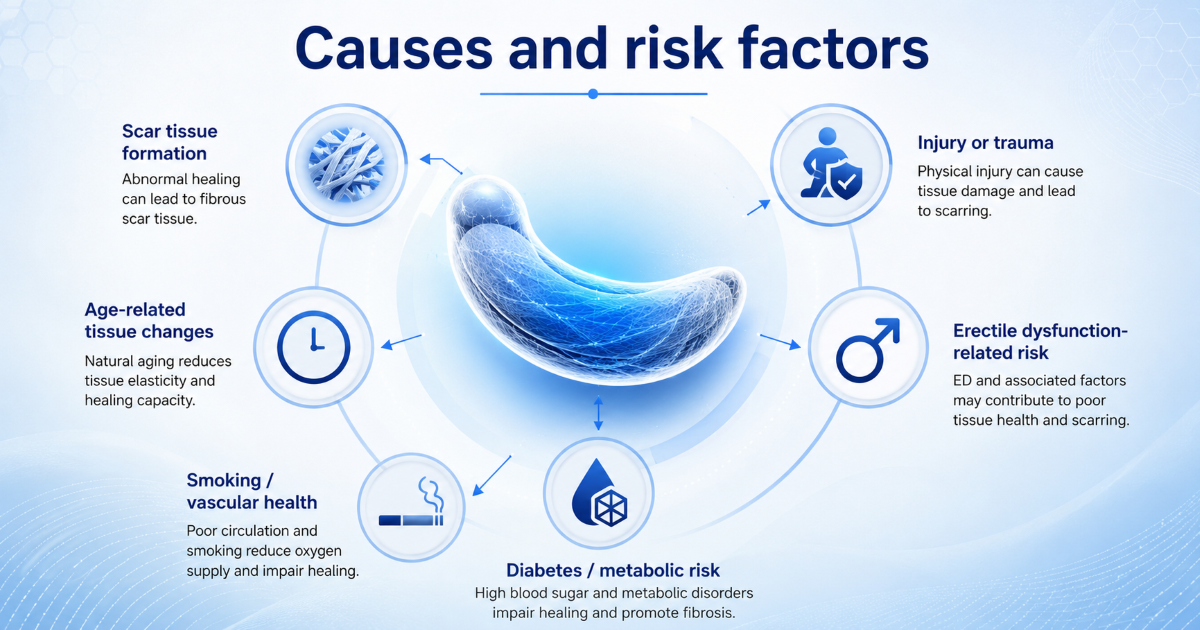
The exact cause is not always identifiable. Many cases are thought to involve abnormal wound healing after repeated micro-injury during sex, sports, accidents, or other bending trauma. However, many patients cannot remember one clear injury. Genetics, aging tissue, diabetes, erectile dysfunction, connective tissue conditions, and inflammatory or healing differences may also contribute.
Micro-injury
Small repeated trauma may trigger inflammation and plaque formation in susceptible men.
Healing response
The issue is not only injury, but how the tissue heals afterward. Scar-like plaque can reduce elasticity.
Risk profile
Age, diabetes, erectile dysfunction, family tendency, and some connective tissue disorders may increase risk.
How a Doctor Assesses a Curved Penis
A useful consultation is not just a quick look at the angle. The doctor should understand the timeline, pain, erection quality, penetration difficulty, plaque location, degree of curvature, penile length concerns, partner impact, previous trauma, medications, and medical conditions such as diabetes or erectile dysfunction.
History and symptoms
When the curve started, whether it is worsening, pain level, erectile function, and whether sex is difficult or impossible.
Physical examination
The doctor may check for plaque, tenderness, skin issues, foreskin problems, and signs that another condition may be involved.
Curvature documentation
Photos of the erection or an in-clinic induced erection may be used when appropriate to measure the curve and plan treatment.
Ultrasound when needed
Ultrasound can help evaluate plaque calcification, blood flow, and erectile function in selected cases.
Peyronie’s Disease Treatment Options
Treatment should match the disease phase and the patient’s goals. In the active phase, pain and curvature may still be changing. In the stable phase, the curve has usually stopped changing and surgical decisions may become more predictable. No option should be presented as a guaranteed cure.
| Option | When it may be discussed | Limitations and cautions |
|---|---|---|
| Observation and follow-up | Mild curve, minimal pain, sex still possible, or early stage where changes are being monitored. | Requires monitoring. Seek reassessment if pain, curvature, or function worsens. |
| Pain management | Active phase with painful erections or inflammation symptoms. | Helps symptoms but may not straighten the penis. |
| Penile traction therapy | Selected patients who can use a device consistently under guidance. | Requires time and adherence. Results vary and improper use may cause irritation or injury. |
| Injection therapy | Selected stable curvature cases, depending on plaque and local regulatory availability. | Can involve bruising, swelling, pain, and rare serious injury. Must be performed by trained clinicians. |
| Shockwave therapy | May be discussed for pain-focused management in selected cases. | Should not be marketed as a guaranteed straightening treatment. Evidence and goals must be explained clearly. |
| Surgery | Stable disease with significant curvature, deformity, penetration difficulty, or severe functional impact. | May involve shortening, sensation changes, erectile issues, recurrence, or need for recovery time. |
When Is Surgery Considered?
Surgery may be considered when Peyronie’s disease is stable and the curve or deformity prevents satisfactory sexual intercourse. The surgical approach depends on curvature direction, degree, penile length, erectile function, plaque characteristics, hourglass deformity, and patient priorities.

Plication
Often discussed for selected curvatures when erectile function is adequate. It may straighten by shortening the longer side, so perceived or actual length change must be discussed.
Incision or grafting
May be considered for more complex deformity in selected patients. It can carry higher risks and requires careful patient selection.
Penile prosthesis
May be considered when Peyronie’s disease is combined with significant erectile dysfunction that does not respond to other treatments.
Warning Signs: When to See a Doctor
Early evaluation can help clarify whether the condition is active, stable, mild, or severe. It can also identify erectile dysfunction, penile fracture history, infection, foreskin problems, or other conditions that may change the treatment plan.
| Symptom or situation | Why it matters | Suggested action |
|---|---|---|
| New curve or rapidly worsening bend | May indicate active disease or recent injury. | Schedule urologic assessment. |
| Painful erections | Often occurs during active inflammation and may need evaluation. | Do not force sex or stretching through pain. |
| Penetration difficulty | Function is a key treatment driver, not just the angle. | Discuss treatment options with a doctor. |
| Erectile dysfunction | ED can coexist with Peyronie’s disease and affects treatment choice. | Assess vascular and sexual function. |
| Snap, pop, swelling, bruising after injury | Could suggest penile fracture, an emergency. | Seek urgent medical care. |
FAQ About Peyronie’s Disease Treatment
What is Peyronie’s disease?
Peyronie’s disease is an acquired penile curvature condition commonly linked with scar-like plaque in the tunica albuginea. It may cause a bend, indentation, shortening, painful erections, erectile dysfunction, or difficulty with penetration.
How much penile curvature is still considered normal?
A mild natural bend that does not cause pain, distress, or difficulty with sexual activity may not need treatment. Medical assessment is recommended if the curve is new, worsening, painful, or interferes with penetration.
Can Peyronie’s disease improve without surgery?
Some patients may be monitored, especially when pain is improving and intercourse is possible. Non-surgical options may include traction therapy, selected injection therapy, erectile function treatment, and pain management, but suitability depends on stage, curvature, plaque features, and erectile function.
When is surgery considered for Peyronie’s disease?
Surgery is usually considered for stable disease when curvature or deformity prevents satisfactory sexual intercourse. Options may include plication, plaque incision or excision with grafting, or penile prosthesis in selected patients with significant erectile dysfunction.
Will Peyronie’s disease treatment make the penis longer?
Treatment aims to improve function, reduce bothersome deformity, and support comfortable sexual activity. It should not be presented as a guaranteed lengthening procedure. Some surgical approaches can involve perceived or actual shortening, so expectations must be discussed before treatment.
Medical References
This page is written for patient education and medical SEO clarity. It does not replace diagnosis, individualized treatment planning, or consultation with a qualified urologic doctor.
- Mayo Clinic: Peyronie’s disease symptoms and causes
- Mayo Clinic: Peyronie’s disease diagnosis and treatment
- NIDDK: Penile curvature and Peyronie’s disease
- European Association of Urology: Penile curvature guideline chapter
- American Urological Association: Peyronie’s disease guideline

Doctor Review and Medical Safety
Peyronie’s disease treatment should begin with diagnosis, stage assessment, erectile function review, and realistic expectations. The goal is to improve function and reduce bothersome deformity while explaining trade-offs such as pain, recurrence, shortening, recovery time, and possible need for additional treatment.
Reviewed by: Dr. Beer, Eternity Clinic
Last content update: 28 June 2026

Latest Articles
What Are the Symptoms of Cystitis? This Article Has the Answers.
Cystitis is inflammation of the bladder. It is often caused by a bacterial bladder infection,
How to Care for Your Manhood to Keep It Strong and Disease-Free
Penis health is not only about sexual performance. It includes daily hygiene, foreskin care, safer
Permanent Solution for Premature Ejaculation with Surgery
Premature ejaculation can be distressing, but it should not be reduced to a single promise
Delayed Ejaculation: Is It Really Good? What to Do If You’re Facing This Issue
Delayed ejaculation may sound positive to some men, but when climax takes much longer than
How to Measure Condom Size Properly: Understanding Sizes 49, 52, 54, and 56
Condom size is not judged by length alone. For most men, the most useful measurement
Penile Enlargement With “Your Own Tissue” or “Your Own Fat”: Why It May Not Be Worth the Pain
Using your own tissue or your own fat can sound more natural than synthetic material,
Circumcision at a Clinic vs Hospital: How to Choose the Right Medical Setting
Adult circumcision can be planned in different medical settings. The safest choice depends on your
Adult Circumcision Explained: Benefits, Methods, Recovery, and Safety
Adult circumcision is a procedure to remove the foreskin covering the head of the penis.