

Shockwave therapy for erectile dysfunction, also called LI-ESWT, LiSWT, or EDSWT, is discussed as a non-invasive option for selected men whose erections are affected by blood-flow problems. It should be approached as a doctor-assessed ED treatment pathway, not as a guaranteed way to restore sexual performance, enlarge the penis, or replace a full medical evaluation.
Shockwave therapy for erectile dysfunction uses low-intensity acoustic waves applied externally to penile tissue. The goal is to support penile blood-flow biology in selected cases, especially when ED is mainly vasculogenic. It is not a universal ED cure. Medical guidelines and research are still cautious because protocols, devices, patient selection, outcome measures, and durability data vary.
What Is Shockwave Therapy for Erectile Dysfunction?
Shockwave therapy for ED uses low-intensity acoustic energy delivered through a handpiece placed on the outside of the penis and nearby treatment areas. It is different from high-energy shockwave treatment used for kidney stones. In ED care, the discussion usually centers on whether low-intensity energy may support vascular repair signals and penile blood-flow response in selected patients.
The most important clinical point is selection. A man with mild to moderate vascular ED may have a different treatment pathway from a man with severe diabetes-related ED, low testosterone, medication-related ED, nerve injury after pelvic surgery, performance anxiety, depression, or Peyronie’s disease.

What Does the Evidence Say?
The evidence for low-intensity shockwave therapy is mixed but clinically relevant. Some randomized trials and reviews report improvements in erectile function scores for selected men, especially vasculogenic ED. At the same time, guideline groups remain cautious because treatment protocols, devices, energy settings, session numbers, and patient populations are not fully standardized.
| Evidence point | What it means for patients | How to discuss it safely |
|---|---|---|
| AUA position | The American Urological Association states that low-intensity ESWT for ED should be considered investigational. | Patients should be told that it is not positioned as a guaranteed standard ED cure. |
| EAU position | European guidance discusses LI-SWT in selected men, especially vasculogenic ED, with attention to evaluation and counseling. | Selection matters. A vascular profile may be more relevant than general sexual performance complaints. |
| Research trend | Some studies suggest benefit, but long-term durability and protocol differences remain important issues. | Ask about device type, treatment course, endpoint, expected timeline, and follow-up plan. |
| Patient expectation | Firmer erections may occur in selected responders, but response is not guaranteed. | Frame the goal as improved erectile function, not permanent restoration or penis enlargement. |
Who May Be a Candidate for ED Shockwave Therapy?
The most suitable candidates are usually men whose ED is partly related to blood-flow problems and who still have some erectile response. However, candidacy cannot be confirmed from age or symptoms alone. It requires a review of medical history, medications, cardiovascular risk, hormone status when relevant, erection quality, relationship context, and prior ED treatments.
May be considered
Selected men with mild to moderate vasculogenic ED, partial response to ED medication, or blood-flow related erection quality concerns.
Needs caution
Men with diabetes, high blood pressure, heart disease risk, low testosterone symptoms, medication-related ED, or psychological stress need broader assessment.
May need another plan
Severe ED, major nerve injury, untreated hormonal problems, active penile pain, significant curvature, or urgent sexual health symptoms may require other care.

What a Doctor Should Check Before Treatment
A good ED consultation should not start with the machine. It should start with the patient. The doctor should understand whether ED is occasional, persistent, situational, progressive, medication-related, vascular, hormonal, neurologic, psychological, or mixed.
Symptom pattern
How often erections fail, whether morning erections remain, whether the problem is with firmness, duration, penetration, or maintaining erection.
Medical risk review
Diabetes, hypertension, high cholesterol, smoking, obesity, sleep problems, heart disease, pelvic surgery, trauma, and medication list can change treatment choice.
Sexual and psychological context
Stress, anxiety, depression, relationship factors, libido, ejaculation problems, and performance pressure may need parallel support.
Physical and laboratory checks when indicated
Selected patients may need blood pressure, glucose, lipids, testosterone evaluation, penile exam, or vascular assessment before treatment planning.
What to Expect During a Shockwave Treatment Course
Protocols vary between clinics and devices. A typical course may involve several short sessions delivered over multiple weeks, but the exact number and spacing should be explained before treatment. The procedure is usually performed externally, with the clinician applying the device to mapped treatment areas.
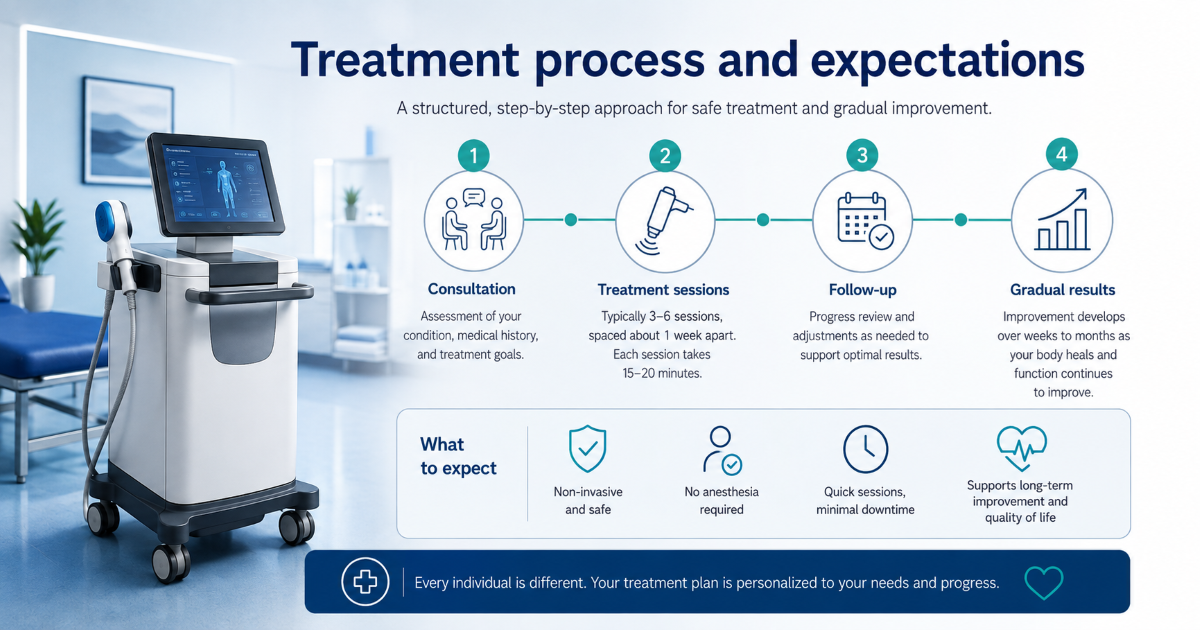
| Stage | What happens | Patient decision point |
|---|---|---|
| Before treatment | ED cause, vascular risk, medication history, and suitability are reviewed. | Ask why shockwave is appropriate for your type of ED. |
| During sessions | Low-intensity acoustic energy is applied externally to treatment areas. | Ask about device, protocol, number of sessions, and expected timeline. |
| Between sessions | Lifestyle, ED medication strategy, and chronic disease management may continue. | Do not stop prescribed medication unless your doctor tells you to. |
| After the course | Response is reviewed through erection quality, function, and patient-reported outcomes. | Plan next steps if response is partial or absent. |
Limits, Risks, and Red Flags
Shockwave therapy is often marketed as simple and non-invasive, but safe marketing should still explain limitations. The treatment does not guarantee restored erections, does not replace cardiovascular risk screening, does not treat all ED causes, and should not be framed as a penis enlargement procedure.
What shockwave may help
- Erection firmness in selected vascular ED cases
- Blood-flow related ED when candidacy is appropriate
- Some patients who want a non-invasive option as part of a plan
What it cannot promise
- Guaranteed cure for ED
- Permanent sexual performance restoration
- Penis length or girth increase
- Replacement for heart, diabetes, or hormone assessment
- Success in every severe or complex ED case
| Red flag | Why it matters | Suggested action |
|---|---|---|
| Chest pain, shortness of breath, or heart symptoms with sex | Sexual activity can stress the cardiovascular system. | Seek urgent medical advice before ED treatment. |
| New ED with diabetes, high blood pressure, or high cholesterol | ED can be linked with blood vessel health. | Request cardiovascular and metabolic risk review. |
| Penile pain, curvature, or lump | Peyronie’s disease or another structural issue may be present. | Have a penile exam and treatment-specific assessment. |
| Low libido, fatigue, or loss of morning erections | Hormonal or systemic factors may contribute. | Discuss targeted lab testing when appropriate. |
| Sudden erection loss after trauma | Could reflect injury that needs urgent care. | Seek prompt medical evaluation. |
FAQ About Shockwave Therapy for Erectile Dysfunction
What is shockwave therapy for erectile dysfunction?
Shockwave therapy for erectile dysfunction uses low-intensity acoustic waves applied externally to penile tissue. It is discussed mainly for selected men with vasculogenic ED, where blood-flow issues are part of the problem. It is not a guaranteed cure and should follow a proper ED assessment.
Is shockwave therapy for ED guaranteed to work?
No. Results vary, and major guidelines differ in how they position the treatment. Candidacy, ED cause, vascular health, device protocol, and treatment course all affect expectations.
Who may be a candidate for ED shockwave therapy?
Selected men with mild to moderate vasculogenic erectile dysfunction may be considered after medical assessment. Men with severe ED, low testosterone, uncontrolled diabetes, major nerve injury, psychological ED, or medication-related ED may need a different or combined plan.
Can shockwave therapy increase penis size?
Shockwave therapy should not be sold as a penis enlargement treatment. If erections become firmer in a suitable patient, the erect penis may feel fuller, but the treatment does not guarantee permanent length or girth increase.
When should erectile dysfunction be checked by a doctor?
Medical assessment is recommended when ED is new, persistent, worsening, associated with pain, chest symptoms, diabetes, high blood pressure, cardiovascular risk, low libido, penile curvature, or medication changes.
Medical References
This page is written for patient education and medical SEO clarity. It does not replace diagnosis, individualized ED treatment planning, cardiovascular risk review, or consultation with a qualified doctor.
- American Urological Association: Erectile Dysfunction Guideline
- European Association of Urology: Management of Erectile Dysfunction
- NIDDK: Symptoms and Causes of Erectile Dysfunction
- NIDDK: Treatment for Erectile Dysfunction
- PubMed Central: Low-intensity shockwave therapy long-term outcomes study
- PubMed Central: Cochrane review summary on low-intensity shockwave therapy for ED

Doctor Review and Medical Safety
Shockwave therapy for erectile dysfunction should be considered only after assessing ED cause, cardiovascular risk, medication history, hormone-related symptoms, penile anatomy, and treatment expectations. The goal is to choose a plan that matches the patient’s ED mechanism and risk profile rather than promising universal restoration of sexual performance.
Reviewed by: Dr. Beer, Eternity Clinic
Last content update: 28 June 2026

Latest Articles
What Are the Symptoms of Cystitis? This Article Has the Answers.
Cystitis is inflammation of the bladder. It is often caused by a bacterial bladder infection,
How to Care for Your Manhood to Keep It Strong and Disease-Free
Penis health is not only about sexual performance. It includes daily hygiene, foreskin care, safer
Permanent Solution for Premature Ejaculation with Surgery
Premature ejaculation can be distressing, but it should not be reduced to a single promise
Delayed Ejaculation: Is It Really Good? What to Do If You’re Facing This Issue
Delayed ejaculation may sound positive to some men, but when climax takes much longer than
How to Measure Condom Size Properly: Understanding Sizes 49, 52, 54, and 56
Condom size is not judged by length alone. For most men, the most useful measurement
Penile Enlargement With “Your Own Tissue” or “Your Own Fat”: Why It May Not Be Worth the Pain
Using your own tissue or your own fat can sound more natural than synthetic material,
Circumcision at a Clinic vs Hospital: How to Choose the Right Medical Setting
Adult circumcision can be planned in different medical settings. The safest choice depends on your
Adult Circumcision Explained: Benefits, Methods, Recovery, and Safety
Adult circumcision is a procedure to remove the foreskin covering the head of the penis.