

Pearling, also called pearl implant or penile beading, can change penile texture and appearance, but it is not a guaranteed way to improve partner pleasure. Before deciding, patients should understand consent, placement, infection risk, aftercare, and whether the procedure fits their real goal.
Pearling may be a reasonable body-modification choice for selected adults who understand the risks, discuss it with their partner, and have it performed in a sterile medical setting. It is not a treatment for erectile dysfunction, premature ejaculation, penis lengthening, or relationship problems.
A safer decision starts with three questions: Why do you want it, does your partner consent and feel comfortable, and are you prepared for wound care, temporary sexual abstinence, and the possibility of infection, migration, discomfort, or removal?
What Is Pearling or a Pearl Implant?
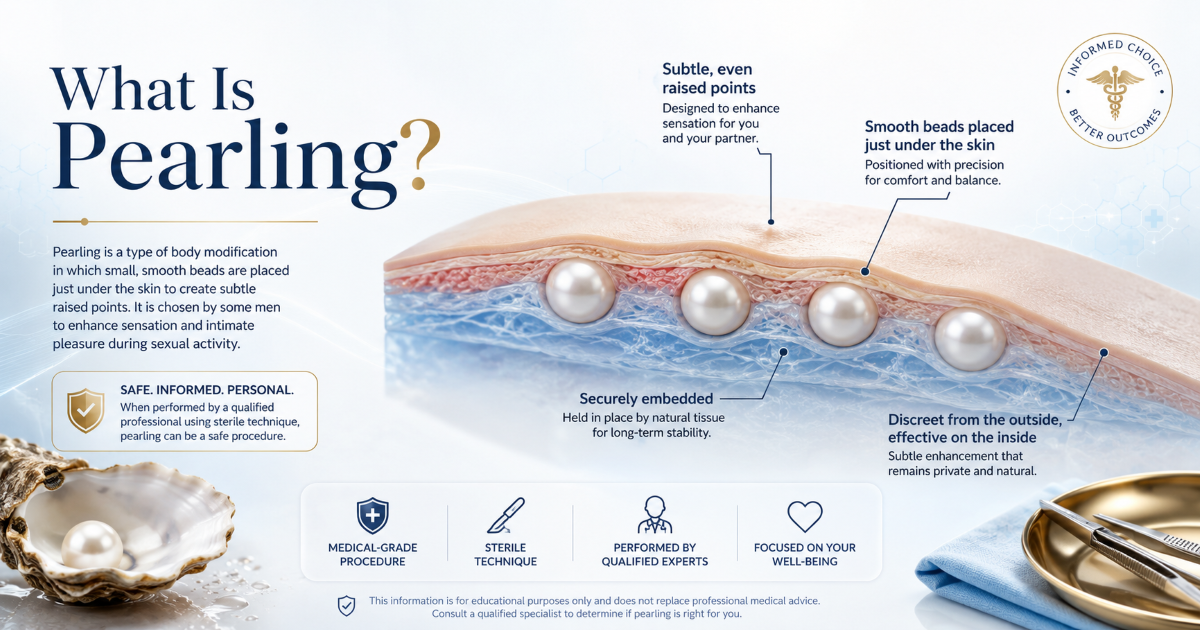
Pearling is a body modification in which small rounded implants are placed under the penile skin. The goal is usually to create raised points or texture that some people find visually appealing or sexually interesting. The effect depends on implant size, placement, tissue thickness, healing, and partner preference.
For patients whose main concern is erection firmness, ejaculation control, or penile size, the better first step is a medical consultation. Relevant service pages include erectile dysfunction treatment, premature ejaculation treatment, and penile filler for girth-focused enlargement.
Is Pearling a Good Idea?
Pearling can be acceptable for some adults when the decision is informed, consensual, and medically supervised. It becomes a poor idea when it is done because of pressure, unrealistic expectations, low-cost illegal implantation, self-insertion, or the belief that pearls automatically improve sex for every partner.
It may fit
An adult patient wants a body modification, understands the risks, has discussed partner comfort, and accepts that sexual response varies.
It may not fit
The goal is to cure ED, delay ejaculation, increase true length, or fix relationship anxiety. Those concerns need a different medical pathway.
It should wait
Active infection, penile skin disease, uncontrolled diabetes, poor wound healing, blood-thinner use, or unclear expectations should be reviewed first.
Potential Advantages and Their Limits
The original article described confidence, sensation, and appearance as possible reasons for pearling. Those can be real motivations, but the wording should be careful because sexual response is subjective and cannot be guaranteed.

| Expected benefit | More accurate wording | What to discuss first |
|---|---|---|
| More confidence | Some men feel more confident because the penis looks more distinctive. | Confidence may also relate to anxiety, erection quality, body-image concerns, or relationship communication. |
| More stimulation | Some partners may like the extra texture, while others may feel discomfort or dislike it. | Discuss consent, condom use, position, healing time, and whether the partner is comfortable with raised implants. |
| Better appearance | The penis may look more textured or customized, but the result depends on placement and healing. | Ask about implant size, number, spacing, symmetry, scar risk, and removal options. |
| More sexual performance | Pearling does not directly treat erection firmness, ejaculation control, libido, or penis length. | If performance is the concern, consider an ED or PE assessment rather than cosmetic body modification first. |
Patients seeking size change should separate the goals clearly. Penile enlargement and penile filler are different procedures from pearling and should be assessed separately.
Risks, Complications, and Warning Signs
A pearl implant involves placing a foreign object under penile skin, so it carries risks. The most important risks include infection, swelling, pain, bleeding, implant migration, skin thinning, partner discomfort, scar formation, altered sensation, and the need for removal.

Early warning signs
- Increasing redness, heat, or swelling
- Throbbing pain that worsens instead of improves
- Pus, bad smell, fever, or chills
- Bleeding that does not settle
- Skin breakdown or exposed implant
Later concerns
- Pearl migration or asymmetry
- Partner pain during intercourse
- Persistent tenderness or numbness
- Scar thickening or skin thinning
- Need for implant removal or revision
If any sign of infection appears, sexual activity should stop and the patient should contact a clinician. A genital implant complication should not be ignored because infection in penile tissue can worsen quickly.
Who Should Think Carefully or Avoid Pearling?
Not every patient is a suitable candidate. A medical consultation should identify conditions that increase complication risk or make the expectation unrealistic.

| Patient factor | Why it matters | Recommended action |
|---|---|---|
| Active genital infection or skin irritation | Implanting through inflamed tissue can increase infection and poor-healing risk. | Treat the skin condition first and postpone the procedure. |
| Uncontrolled diabetes or poor wound healing | Healing can be slower and infection risk may be higher. | Review medical control and wound-healing risk before booking. |
| Blood thinners or bleeding disorder | Bleeding and bruising may be more difficult to control. | Do not stop medication on your own. Ask the prescribing doctor. |
| Unclear partner consent | Texture changes may cause partner discomfort or relationship conflict. | Discuss expectations and consent before the procedure. |
| ED, PE, or size anxiety as the main issue | Pearling does not treat these medical concerns. | Start with a sexual-health assessment and choose the correct treatment pathway. |
Patients with tight foreskin, recurrent balanitis, or cleaning difficulty may need a separate assessment for phimosis or adult circumcision before considering any penile aesthetic procedure.
What to Ask Before Implanting Pearls
A good consultation should make the decision clearer, not simply sell the procedure. Use the questions below to compare clinics and to decide whether pearling matches your goal.

The clinic should explain the implant material, size options, sterilization, and why the selected material is appropriate.
Placement should be individualized. More pearls or larger pearls are not automatically better.
Ask about dressing, cleaning, medication, abstinence from sex, condom use after healing, and follow-up visits.
The clinic should explain warning signs, emergency contact, removal method, and revision policy.
If your concern is erection, ejaculation, length, girth, or foreskin tightness, the doctor should redirect you to the correct medical assessment.
Pearling vs Other Male Sexual Health Procedures
Many patients confuse pearling with penile enlargement or sexual-performance treatment. The table below helps separate these services before choosing the wrong procedure.
| Procedure | Main goal | What it does not do | Useful internal guide |
|---|---|---|---|
| Pearling / pearl implant | Texture and body modification | Does not treat ED, PE, true length, or fertility | Pearling risks |
| Penile filler | Girth-focused enlargement and contour | Does not reliably increase true length | Penile filler guide |
| ED treatment | Erection firmness and function | Does not require pearling | ED treatment |
| PE treatment | Ejaculation control | Does not depend on pearl implants | Premature ejaculation treatment |
| Adult circumcision | Foreskin, hygiene, phimosis, selected medical indications | Does not guarantee performance or size improvement | Circumcision guide |
FAQ About Pearling Before Implanting Pearls
Is pearling good for every man?
No. Pearling is preference-based and should be considered only after reviewing health status, expectations, partner comfort, implant material, and aftercare ability.
Can pearl implants make my partner happier?
Not reliably. Some partners may like the texture, while others may feel discomfort or dislike it. Consent and communication are essential before the procedure.
Does pearling increase penis size?
It creates raised areas under the skin, but it is not a true penis lengthening procedure and is not the same as girth-focused penile filler.
Can pearling treat erectile dysfunction or premature ejaculation?
No. ED and PE require separate assessment. Pearling does not improve blood flow, erection hardness, ejaculation control, libido, or hormone levels.
What are the most important risks?
Key risks include infection, pain, bleeding, swelling, implant movement, skin thinning, scarring, altered sensation, partner discomfort, and possible removal.
How long before sex after pearling?
The healing timeline varies. Sexual activity should wait until the wound is fully healed and the doctor confirms it is safe. Starting too early can increase infection, wound opening, or partner discomfort.
Should circumcision be done before pearling?
Not always. Circumcision depends on foreskin anatomy, hygiene, phimosis, recurrent inflammation, and doctor assessment. It should not be presented as mandatory for every pearling patient.
Medical References
- NHS. Infected piercings: signs of infection, hygiene advice, and when to seek help.
- Mayo Clinic. Piercings: prevention of infection, allergic reactions, scarring, and other complications.
- PubMed Central. Complications of subcutaneous penile modifications and emergency removal cases.
- Journal of Sexual Medicine / SMSNA. Cosmetic penile enhancement procedures position statement and safety considerations.
- Cleveland Clinic. Body piercing infection and penis piercing aftercare resources.
This article is educational and does not replace in-person medical consultation. Individual risk depends on anatomy, health conditions, implant material, technique, and aftercare.

Doctor Review and Medical Safety
Pearling should be approached as an intimate body-modification procedure with real medical risks. A safe plan starts with patient goals, partner consent, sterile technique, implant selection, wound care, and a clear plan if infection, migration, discomfort, or removal becomes necessary.
Reviewed by: Dr. Beer, Eternity Clinic
Last content update: 24 June 2026

Latest Articles
What Are the Symptoms of Cystitis? This Article Has the Answers.
Cystitis is inflammation of the bladder. It is often caused by a bacterial bladder infection,
How to Care for Your Manhood to Keep It Strong and Disease-Free
Penis health is not only about sexual performance. It includes daily hygiene, foreskin care, safer
Permanent Solution for Premature Ejaculation with Surgery
Premature ejaculation can be distressing, but it should not be reduced to a single promise
Delayed Ejaculation: Is It Really Good? What to Do If You’re Facing This Issue
Delayed ejaculation may sound positive to some men, but when climax takes much longer than
How to Measure Condom Size Properly: Understanding Sizes 49, 52, 54, and 56
Condom size is not judged by length alone. For most men, the most useful measurement
Penile Enlargement With “Your Own Tissue” or “Your Own Fat”: Why It May Not Be Worth the Pain
Using your own tissue or your own fat can sound more natural than synthetic material,
Circumcision at a Clinic vs Hospital: How to Choose the Right Medical Setting
Adult circumcision can be planned in different medical settings. The safest choice depends on your
Adult Circumcision Explained: Benefits, Methods, Recovery, and Safety
Adult circumcision is a procedure to remove the foreskin covering the head of the penis.